
Where Spirit Meets Light: Bhutan Through a Fine-Art Lens
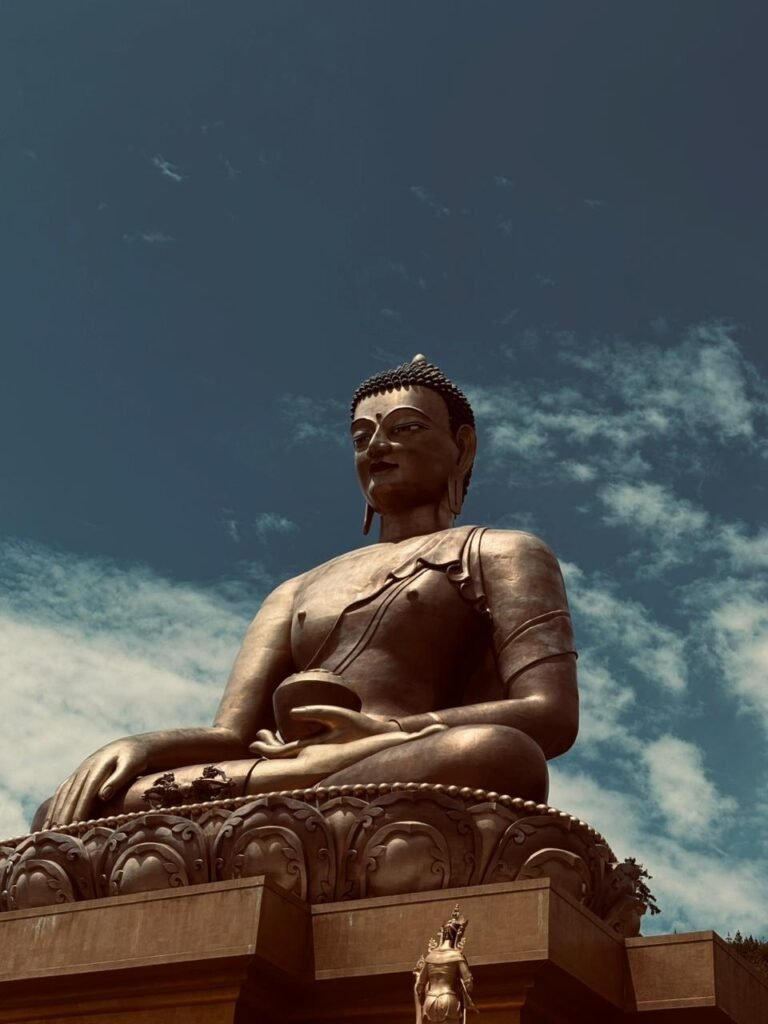
Where Spirit Meets Light: Bhutan Through a Fine-Art Lens
A Quiet Beginning in Thimphu
I didn’t meet Bhutan in the drama of its postcard landscapes or the grand sweep of fortress-monasteries perched on cliffs. I met it on a quiet street in Thimphu — just after sunrise — when the city was still stretching its limbs awake.
The air was cold enough to sharpen the senses, that crisp Himalayan clarity that makes colors feel honest and edges feel true. A lone shopkeeper rolled up his shutters with an unhurried grace, as if the day were something to be welcomed, not conquered. Prayer flags fluttered overhead, their red, blue, yellow, green, and white catching the first slant of light. A monk in deep maroon robes walked past, hands hidden within his sleeves, his steps unbothered by pace or purpose as we define it.
Nothing remarkable happened in that moment — and yet, everything did.
I realised that Bhutan isn’t a place that tries to impress you.
It invites you to slow down until you can see it — truly see it.
As a photographer, I felt my internal shutter slow too. The instinct to “capture” faded; the desire to witness took its place.
In that simple Thimphu street, Bhutan began to reveal its visual philosophy:
beauty here is not performed — it is lived.
⸻
A Fine-Art Photographer’s First Encounter with Bhutan
Bhutan is often described in spiritual terms, but what surprised me most was how visually spiritual the country feels. The harmony between architecture, landscape, and daily life is not accidental — it is intentional, preserved, protected, and practiced.
For a fine-art photographer, Bhutan offers something rare in our hyper-curated world:
authenticity without spectacle.
Every frame feels untouched by noise — both literal and visual. Buildings are designed to exist with the mountains, not against them. Monasteries hum quietly with centuries of prayer. Even the colors — vivid, symbolic, ritualistic — feel grounded by purpose rather than aesthetics alone.
Bhutan doesn’t ask to be photographed; it allows itself to be received.
This shift in the photographer’s mindset is essential here:
Bhutan rewards presence more than technique.
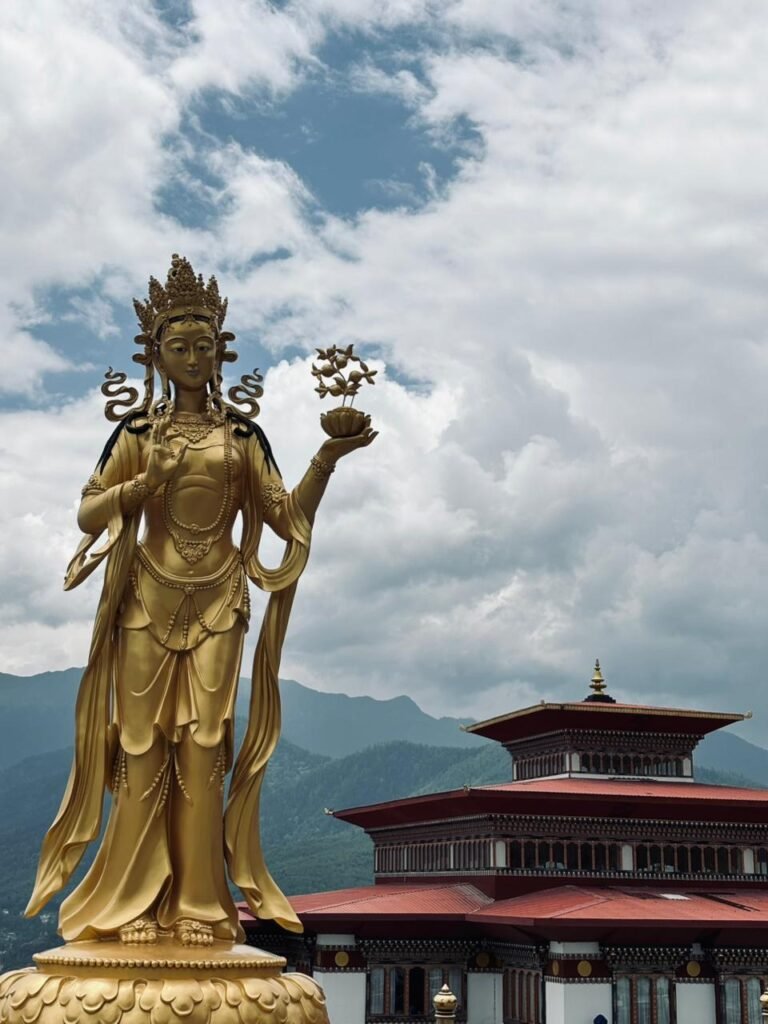
Bhutan’s Visual Identity: Where Culture, Architecture & Light Align
Bhutan’s visual language is built on four pillars — each deeply interwoven with the others:
1. Architecture that Breathes Culture
From dzongs (fortress-monasteries) to wooden homes dressed in hand-painted motifs, Bhutanese architecture follows guidelines that preserve identity. Even modern buildings echo traditional lines, windows, and colors — a rare national commitment to aesthetic continuity.
Expect to see:
• Whitewashed walls that glow under mountain light
• Ornate window frames with floral and geometric patterns
• Timber architecture rich with warm brown tones
• Sloped roofs with red-ochre borders
• Symmetry balanced with storytelling detail
Photography purpose:
Show architecture not as structures, but as vessels of living culture.
2. Color With Meaning, Not Decoration
Bhutan’s colors are symbolic, not ornamental — every hue carries intention.
• Red & Maroon: spiritual discipline, monastic life
• Saffron: sacred power, wisdom
• Deep Blue: sky, purity, protection
• Green: harmony with nature
• White: peace, clarity, compassion
Unlike many Asian destinations known for visual overstimulation, Bhutan’s palette is bold yet composed — a photographer’s dream for striking contrast.
3. Landscape as a Silent Co-Author
The Himalayas are not a background here; they are a presence.
Mist, altitude, wind, silence — they shape the visual tone of Bhutan.
Architecture blends into terrain, not upon it. Dzongs guard valleys, monasteries cling to cliffs, villages nestle in folds of land — all working with the mountain’s mood.
Photographic impact:
Land and structure form one frame, one story.
4. Spirit as a Visual Element
Prayer wheels turn. Incense rises. Butter lamps flicker. Prayer flags carry mantras in the wind.
Bhutan makes the invisible visible — and that offers a different layer of photography beyond form, color, and composition.
Your subject is not just what you see — but what is felt.
⸻
The Bhutanese Aesthetic Philosophy: Simplicity With Soul
Bhutan’s design principles are rooted in Buddhist values:
• Humility: nothing exists to overpower
• Harmony: every element supports the whole
• Purpose: beauty is a carrier of meaning
• Impermanence: nature, time, and spirit are allowed to shape the visual world
Photographing Bhutan requires a similar approach.
You don’t impose your style onto the place — you listen to what the space asks of your lens.
It is an invitation to refine your eye:
• from dramatic to intentional
• from capture to connection
• from image-making to meaning-making
Paro Taktsang — the Tiger’s Nest
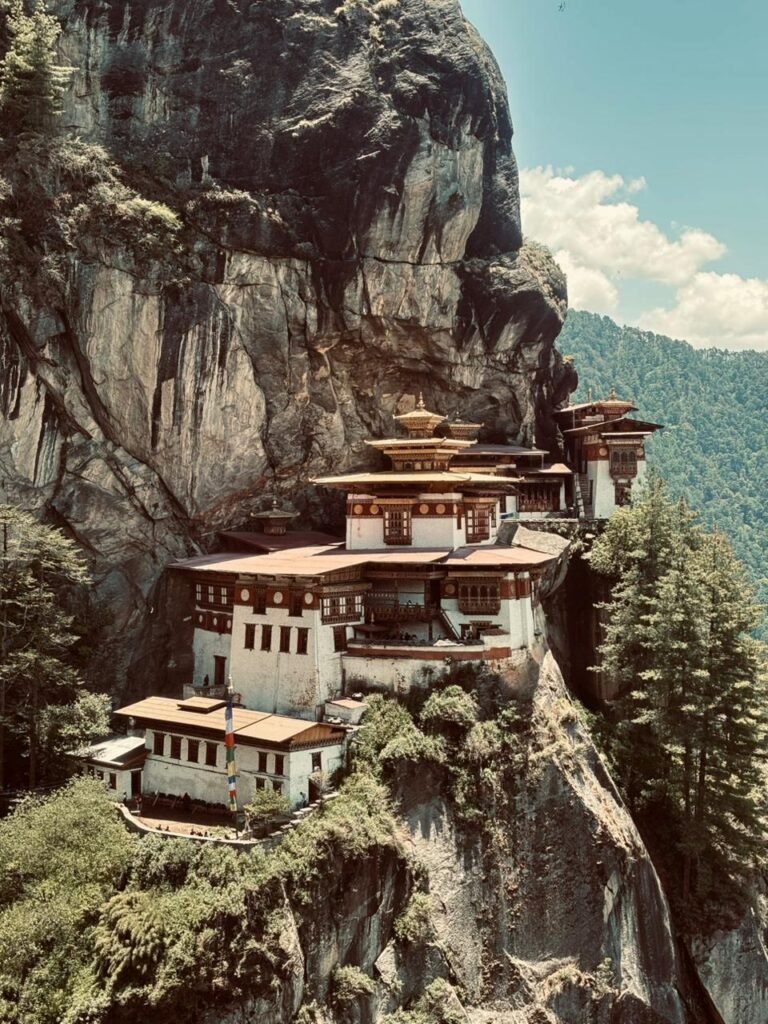
The last stretch of the climb to Paro Taktsang — the Tiger’s Nest — doesn’t feel like a hike anymore. It feels like an approach. The kind where conversation naturally fades, footsteps slow down, and the mountain requests a quieter version of you.
As I reached the cliffside viewpoint, the monastery revealed itself across the gorge — poised with such balance and intention that I paused without needing to remind myself to. There it was: white walls, saffron-trimmed windows, and dark timber frames tucked into the granite, as if the cliff had shaped itself around the structure rather than the other way around. A waterfall dropped beside it in a soft white ribbon, dissolving into mist that hung in the air like a veil. It wasn’t dramatic. It was composed — serene, assured, grounded.
In that moment, I understood why people call visiting Tiger’s Nest a “pilgrimage” even when they arrive without religious intent. There is a natural shift that happens in the final approach — not spiritual in a grand sense, but personal, inward, steady. The kind that photography quietly trains you for: the art of paying attention.
Arriving, Not Capturing
I didn’t raise the camera immediately. The scene deserved a moment of stillness first. From this distance, the monastery doesn’t overwhelm. It invites. The colors are muted yet certain, the geometry almost impossibly harmonious with the cliff. As a photographer, I was struck by how complete the frame already felt to the eye before a lens was even involved.
Tiger’s Nest is a subject that resists the urge for over-composition. It is already a composed story — what you add must respect that balance.
When I eventually lifted the camera, I focused less on making a “big shot” and more on understanding why the scene felt balanced. That clarity shaped the way I would photograph the monastery throughout the visit.
The Approach With a Photographer’s Eye
The final stretch naturally slows a photographer down — altitude, uneven stone steps, and a silent awareness that this location carries significance for many. The path hugs the cliff, bordered by prayer flags moving in quiet rhythm with the breeze. As I walked, I noticed how the light changed — brighter on the right-hand rock faces, diffused on the monastery across the ravine.
This is a key detail for photographers: the best compositions here rely on contrast, not dramatic edits. The scene provides its own depth — cliff shadow vs. monastery illumination.
I found three subtle ways to read the light on the approach:
• The mid-morning light gives clean edges and clarity to the structure
• The afternoon glow softens the whites and warms the ochre trims
• If clouds roll in, the monastery looks like it has emerged from air rather than stone
None of these are “better.” They offer different moods. Tiger’s Nest is one of the rare subjects that holds its dignity in every lighting condition — even flat light works, because the silhouette and placement are visually powerful on their own.
Inside the Monastery
After leaving cameras and bags at the entrance (required), the shift is immediate. The sound changes — softer, lower, textured with murmured prayers and the occasional ring of a bell. Butter lamps flicker, painting warm gold strokes against the stone walls. The interior is intimate, not grand. The rooms are small, with steep wooden staircases connecting spaces layered with centuries of devotion.
Without a camera, I found myself observing more intently. Texture, color, rhythm — the same elements that guide photography — became even more noticeable. Inside, Tiger’s Nest is not visually loud. It is quietly detailed. The kind of detail that teaches restraint.
As a photographer, it’s valuable to absorb this atmosphere without the lens. It informs how you shoot once you step outside again.
The Photographer’s Return to the Outside View
When I stepped back out after the monastery visit, I saw the location differently. Not as a viewpoint, but as a dialogue — cliff, air, water, structure.
This is where photography becomes interpretation rather than documentation.
I focused on three compositional approaches that best honour the space:
1. The Balanced Wide (Respectful Perspective)
A wide shot that positions the monastery slightly off-center, giving equal visual weight to the cliff and the sky. This expresses the relationship between structure and landscape — the monastery does not conquer the cliff, it coexists with it.
2. The Story Detail (Without Intrusion)
Close studies of elements like prayer flags, stone steps, or hands turning a prayer wheel — captured outside the monastery to respect the no-photography rule. These images communicate experience without invading sacred space.
3. The Human Scale Shot
Including a respectful human silhouette or a pilgrim in the frame gives the monastery scale and narrative. It reminds viewers that this is a place people journey to, not just a scenic marvel.
Shooting With Sensitivity
Photographing Tiger’s Nest is as much about when not to shoot as when to shoot. The location holds emotional meaning for many who visit — and awareness of that is essential. I avoided pointing the lens at anyone in visible prayer or meditation. If someone appeared in a frame, I ensured they were contextual, not focal.
Fine-art photography here means honoring the story, not extracting it.
Why Tiger’s Nest Matters to a Fine-Art Photographer
Tiger’s Nest is visually striking, yes — but what makes it important for a fine-art photographer is something deeper:
• It demonstrates balanced design in a setting that defies logic
• It embodies Bhutan’s relationship with faith, land, and restraint
• It shows how architecture can co-exist with nature without diminishing it
For a photographer, this location reinforces a principle I carry into architectural work:
Space holds meaning when it listens to what surrounds it.
Tiger’s Nest isn’t iconic because it is placed on a cliff. It is iconic because it feels right there.
Leaving With Less Than You Came
On the descent, I felt lighter. Not in a dramatic way — simply more aligned. The experience didn’t need big words or life-changing revelations. It offered clarity, the quiet kind that lingers.
Photography teaches us to see. Tiger’s Nest teaches us to see without needing to take.
I carried only a few images from the visit, but they felt purposeful — not collected, but earned.