
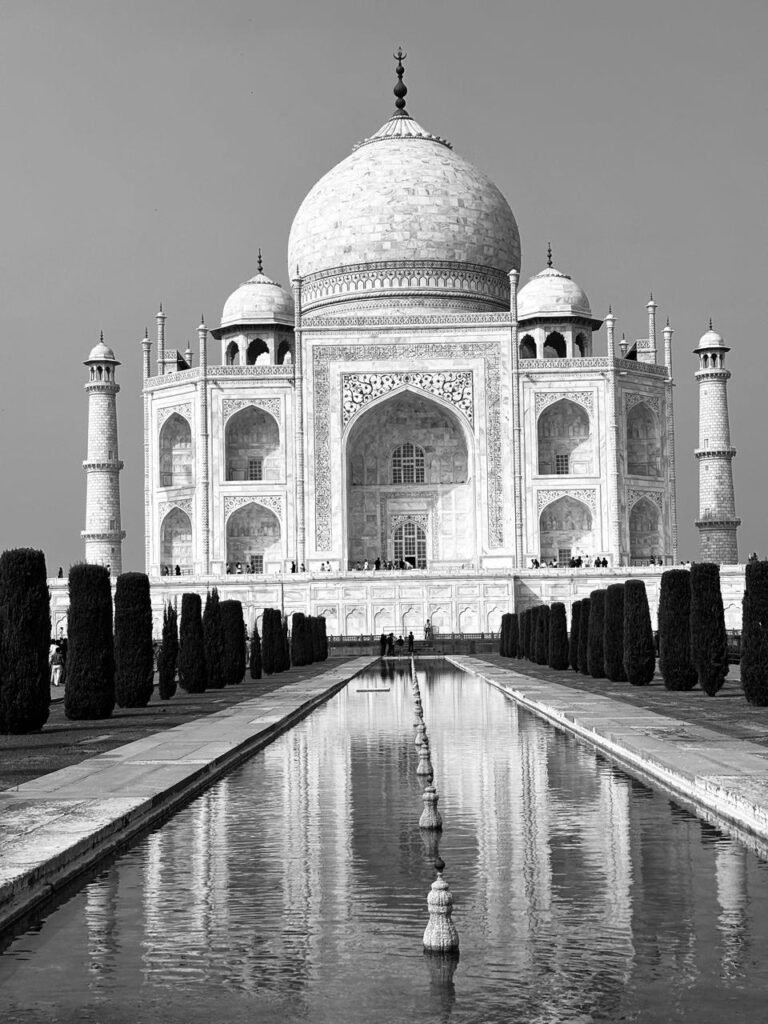
Where Marble Breathes Light: A Fine-Art Architectural Photography Journey Through the Taj Mahal
Introduction: When Architecture Becomes Emotion
Some monuments are seen.
A few are admired.
But the Taj Mahal — it is felt.
At dawn, when the first light spills over the Yamuna and the white Makrana marble blushes into the faintest rose, the Taj Mahal stops being a structure. It becomes a breath — a quiet exhale of devotion, symmetry, and soul. For an architectural photographer, it is a place where geometry learns poetry, and stone learns softness.
Walking through the Darwaza-i-Rauza, the grand entrance gate, the Taj reveals itself like a slow, deliberate composition. It does not impose; it invites. And that is the first lesson it teaches a photographer — great architecture doesn’t demand to be captured; it asks to be understood.
In this guide, I will take you through the Taj Mahal not as a tourist destination, but as a fine-art canvas of light, symmetry, cultural meaning, and photographic intention. While I share technical insights, I will also reveal observations gathered through the lens — the kind that only emerge when you stand still enough to hear marble speak.
⸻
The Architectural Soul of the Taj Mahal — Understanding Its Visual Language
Before photographing architecture, one must learn to read it.
The Taj Mahal is written in the language of:
• Perfect symmetry
• Precise geometry
• Spiritual symbolism
• Visual equilibrium
• Harmonic proportions inspired by Persian and Mughal design
Knowing its design intent allows you to photograph it with respect, depth, and clarity.
1. Symmetry as an Emotion, Not Just a Design Choice
Every line, arch, minaret, and garden axis aligns with a mathematical precision that borders on divine.
But here is the nuance many photographers miss:
Symmetry at the Taj Mahal isn’t merely visual — it’s symbolic.
It represents eternal balance, the equilibrium between life and afterlife, earth and heaven, love and remembrance.
When you compose, don’t just “center” your frame.
Feel the symmetry.
Lean into the stillness it creates.
Photographic Insight:
When your frame is perfectly symmetrical, hold it for a moment before clicking. If it makes you feel calm, you’re aligned — both visually and emotionally.
2. Geometry that Guides the Eye
The Taj is a masterclass in geometric guidance.
The architecture is designed to draw your eye toward the mausoleum no matter where you stand. As a photographer, align with that intention — let your composition guide the viewer’s gaze gently toward the dome.
3. The Dome: The Heartbeat of the Composition
The marble dome, often described as a “perfect pearl,” is not just a central design element — it is the visual and emotional anchor of the Taj.
Notice:
• It is slightly elevated, enhancing its celestial presence
• The bulbous form softens the structure’s geometry
• It reflects light differently throughout the day
Try photographing the dome as if it were a character — not a building part.
Give it space to breathe in your compositions.
4. Cultural & Spiritual Subtext to Honor Through the Lens
As a photographer, especially one with a fine-art and cultural sensitivity approach, one must acknowledge:
• The Taj is a tomb, not a palace
• It is a memorial of eternal love, not a tourist backdrop
• It is a UNESCO World Heritage Site with deep Islamic and Mughal cultural roots
This awareness influences how you shoot:
• Avoid over-romantic poses or commercial staging near the main structure
• Keep compositions respectful, minimal, and mindful
• Seek to capture emotion, not spectacle
Photography should preserve its sanctity, not dilute it.
⸻
Before You Lift the Camera: Arrive With Intention
Many visitors rush to photograph the Taj instantly. A fine-art architectural photographer should do the opposite.
Here’s a small personal ritual I recommend — one that refined the way I shoot heritage architecture:
1. Enter without your camera raised
2. Walk in silence toward the main platform
3. Stop at the central axis and simply look
4. Observe the play of shadow, reflection, and human movement
5. Then decide: What emotion do I want my images to carry today?
This simple act shifts your mindset from capturing a monument to interpreting an emotion made of marble and light.
The Dance of Light on Marble — Photography Timing & Light Behavior
If the Taj Mahal is a poem in stone, light is the ink that rewrites it every hour.
For a fine-art architectural photographer, understanding how Makrana marble reacts to light is more valuable than any gear you carry. The Taj is one of the few monuments in the world that changes personality with light — from ethereal softness to sculptural drama.
Here’s how the Taj transforms through the day:
Recommended for: Fine-art shots, symmetry studies, editorial frames, foggy winter captures
• Subtle pastel hues paint the marble in whispering pinks and lavender tones
• Shadows are gentle, preserving the monument’s serenity
• Reflections in the water channels are clean and undisturbed
If you want to convey the Taj Mahal’s soul, shoot at dawn.
If you want to capture its perfection, shoot moments after sunrise.
Winter sunrise often brings soft mist over the Yamuna — a dreamy, minimal backdrop perfect for fine-art storytelling.
Recommended for: Warm editorial, cultural storytelling, details of inlay work
• The marble warms to a creamy, golden tint
• Pietra dura floral patterns become more pronounced
• The dome glows with a pearl-like radiance
Ideal for capturing texture, details, and human scale.
Recommended for: Sharp architectural definition, tilt-shift lens work
• Crisp shadows carve out the monument’s form
• Highlights are clean, offering high-contrast compositions
This is when the structure photographs “architecturally” — bold, sharp, defined.
Recommended for: Minimalist, fine-art monochrome work
• Light becomes diffused and even
• Marble reads as white, almost paper-like
• Perfect for black & white architectural frames
Cloudy days are a gift, not a setback, for fine-art photographers.
The Taj Mahal under moonlight is surreal — the marble turns silvery-blue, almost translucent. Night viewing is allowed on specific nights, with restrictions.
If you ever get the chance, don’t photograph it immediately.
First, stand still — your eyes must adjust to the quiet, celestial glow.
⸻
Gear & Lens Choices for Fine-Art Architectural Photography at the Taj
While creativity outweighs equipment, certain tools help bring architectural purity to life.
Camera Bodies
• Full-frame bodies recommended for dynamic range
• Look for excellent highlight retention — marble detail easily blows out
• Silent shutter preferred for respectful shooting
Filters & Accessories
• Circular Polarizer: Enhances sky & reflections, but use lightly
• ND Filters: For long exposure on water channels
• No Tripods Allowed: Unless with special permission (rare), so plan for handheld stability
A note of respect: Avoid bringing intrusive or commercial-looking gear unless officially permitted.
This is a place of heritage and sentiment.
⸻
Iconic & Less-Photographed Angles — A Fine-Art Approach
While most visitors shoot the same postcard frames, fine-art photographers seek variations in perspective, emotion, and narrative.
Here are compositions that balance heritage respect with artistic intention:
1. Framed Through the Main Arch (Darwaza-i-Rauza)
• The classical intro shot — but refine it
• Use the arch’s darkness to create a natural vignette
• Align the dome perfectly within the arch apex for harmony
Pro Tip: Wait for a single human figure to walk across the frame — scale adds poetry.
2. Reflection Pools — Less is More
Most shoot from the center. Try:
• Off-center minimal reflections
• Symmetry broken slightly for a human touch
• Detail-only reflections — no monument, just ripples of marble upside-down
This creates gallery-worthy abstract frames.
3. The Mosque & Jawab Wings
These sandstone buildings flanking the Taj offer:
• Shadow patterns
• Mughal arches for framing
• A warmer color palette for contrast against the white marble
Compose using shadow geometry.
4. Mehtab Bagh — The Balanced Perspective
Across the Yamuna river, the Taj reveals a calmer, more contemplative personality.
• Shoot at sunset for silhouette style
• Ideal for negative space compositions
• The Taj appears with greater emotional distance — a quiet love letter of an image
5. Yamuna River Bank (Rare Angle)
This is for photographers who seek intimacy and silence — a view that feels like a memory rather than a monument.
Not always accessible, but when permitted, it gives:
• A raw, stripped-down perspective
• Human-scale connection
• Soft reflections without crowds
⸻
Compositional Storytelling Techniques for the Taj
Fine-art architectural photography is not just about accuracy — it’s about interpretation.
Here’s how to tell a story with each frame:
• Symmetry = Serenity
Use for calm, meditative images
• Asymmetry = Emotion
Shift the dome or minaret slightly off-center to introduce narrative tension
• Foreground Elements
Use arches, lattice screens, calligraphy bands, or visitor silhouettes
• Leading Lines
Water channels, pathways, and garden axes guide the viewer inward
• Minimalist Crops
Isolate patterns, calligraphy, or dome curves for fine-art prints
Your role is to reveal how light, geometry, and meaning coexist — not compete.
⸻
A Cultural Note: Photograph People with Sensitivity
If including people:
• Seek natural moments, not staged poses
• Respect visitors’ privacy and emotional connection
• Use silhouettes or soft distance to portray reverence
The Taj is a resting place, not a backdrop.
When to Work with a Professional Architectural Photographer
Many believe the Taj Mahal is “easy to photograph” because of its beauty. But capturing it with artistic intention, narrative depth, and architectural purity is a different craft.
A seasoned fine-art architectural photographer brings:
1. Understanding of Architectural Intent
Composition aligns with Mughal design principles — symmetry, axis, balance, geometry.
2. Fine-Art Visual Language
Images that belong in galleries, editorial publications, and curated collections — not just social media.
3. Preservation-Focused Approach
Photography that respects and protects heritage value, rather than commercializing it.
4. Tailored Visual Storytelling
Whether for cultural publications, museums, luxury travel brands, or heritage projects, each frame is created with purpose, not repetition.
A fine-art photographer’s role is not only to capture what the Taj Mahal looks like —
but to translate what it feels like.
If a brand, publication, museum, or heritage institution seeks to portray the Taj Mahal through a sophisticated, culturally-sensitive lens — collaboration with a fine-art architectural photographer ensures authenticity and depth.
⸻
Closing: The Image You Take vs. The Memory You Leave
Long after your camera powers down, the Taj remains — unchanging, eternal, spilling light into the Yamuna mist. But the way you choose to interpret it becomes your legacy.
Fine-art architectural photography is not about chasing the most unique angle. It is about seeing with intention, feeling with humility, and creating images that breathe the quiet poetry of marble and light.
The Taj Mahal reminds us:
• Perfect symmetry can still hold emotion
• Stone can feel weightless
• Silence can be the most powerful composition
If your photographs allow someone to feel something — peace, awe, stillness, devotion — then you have done justice to this monument of love and light.